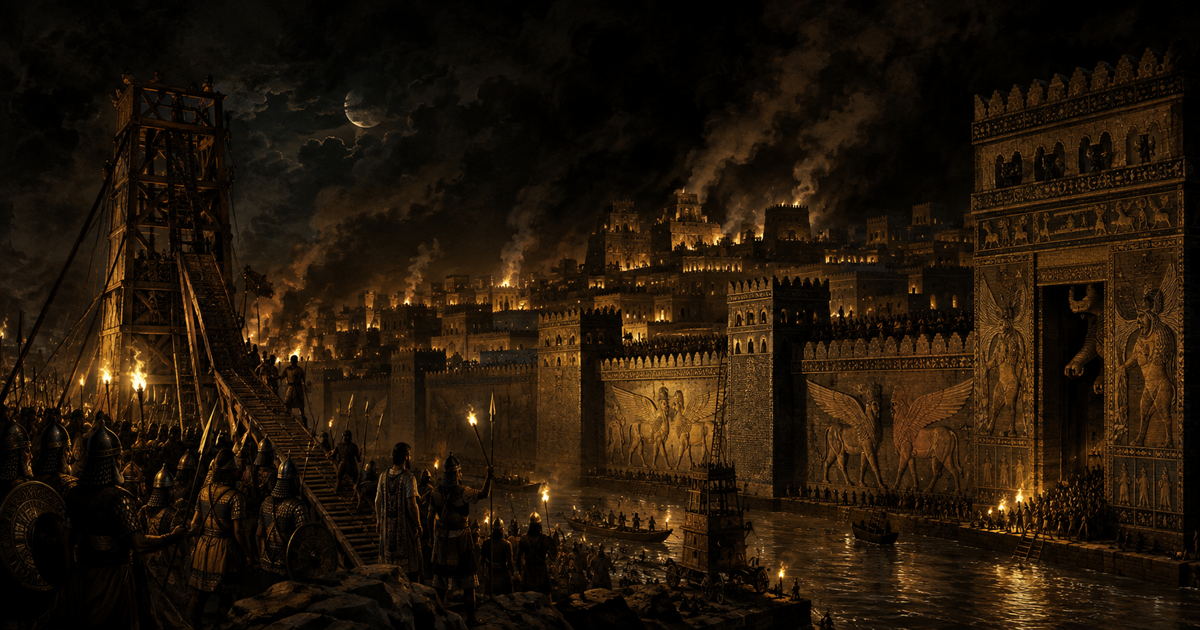
The crackle of burning roofs filled the air. From the east, the screams broke into short gasps. The walls still held.
(from the prologue of Threads of Time: Caesar’s Seal)
Hours later, those walls would hold no longer. It is 612 BC, and that night marks the fall of Nineveh, the most powerful city of its age. On this much, the sources agree. On what actually brought down its defences, they do not agree at all, and the most compelling of the three reconstructions reveals itself as legend the moment you check it against a map.
What the source closest to the events says
The Babylonian Chronicle, known through a Late Babylonian copy now held at the British Museum, records a siege from the month of Simanu to Abu, three months, roughly between June and August of 612 BC. It recounts the city’s defeat, the death of King Sin-shar-ishkun, the sack, the reduction of Nineveh to a heap of ruins.
Not a word about rivers, rain, or dams. On how the defences were actually breached, the text closest to the events says nothing at all.
The story that gives itself away
Five and a half centuries later, the Greek historian Diodorus Siculus told a far more cinematic story. He took it from Ctesias, a Greek physician who lived at the Persian court a couple of centuries after the events, whose original text is now lost: we know it only through Diodorus, and it is not always clear where Ctesias ends and later reworking begins. In this version the siege lasts two years, not three months. In the third year, a river in flood breaches the walls, like a prophecy finally fulfilled. King Sardanapalus, portrayed as a dissolute ruler, sets himself on fire in his own palace rather than surrender.
It is a magnificent scene. It also has a fatal flaw: the river Diodorus names is the Euphrates. Nineveh stands on the Tigris. It is not an isolated slip: the entire city, in the account passed down through Diodorus, is placed on the Euphrates, as if Nineveh had been confused with Babylon.
This is not a detail to quietly correct, like a typo. It is proof that the tradition had already been rewritten several times before reaching Diodorus. The prophet Nahum, writing before the city’s fall, had already used the image of the river gates opening to describe divine judgement. It may be that this metaphor, over time, was taken literally, and turned into an event that actually happened.
A serious hypothesis, and an archaeologist who put it to the test
A more modern hypothesis tries to save the idea of the river while removing the miracle: not a natural flood, but sabotage. Joann Scurlock proposed that the besiegers had deliberately manipulated the waters of the Khosr, the stream running through Nineveh, and its connected channels, to strike a section of the fortifications.
David Stronach, who between 1987 and 1990 led excavation campaigns at Nineveh focused precisely on the gates, the surviving mudbrick walls, and the city’s water system, put that hypothesis to the test in the field. He concluded that the speed of the siege did not necessarily need to depend on an attack on the Khosr or other watercourses, reduced as they were by the summer season. He preferred another explanation: very long walls, too many gates, and defenders who simply were not enough to hold them all.
Water as a weapon remains a legitimate hypothesis. It is not, however, what the excavations confirm.
What the excavations actually show
Near the Halzi Gate, the earth has yielded a genuine battle scene: human remains, traces of burning, arrowheads and other weapons scattered across the area. The bodies still lay where they had fallen. The passage had been narrowed, and one of the nearby towers had been hastily rebuilt, with irregular masonry, probably in the last desperate years of Assyrian rule.
It is evidence of a city that had tried to reinforce itself, and that, at least there, at the Halzi Gate, fought to the end. It is not evidence that water decided its fate.
A declared licence, not a discovery
Threads of Time: Caesar’s Seal opens on that same night, with a man making real, with his own hands, what posterity would recount as a wonder. The novel chooses one of the hypotheses still open, that of water deliberately diverted, and turns it into an act carried out by someone acting on the orders of a figure who never shows his face.
This is not what archaeology has proven. It is what an empty space in the sources, a hypothesis never confirmed, and a geographical error that betrays centuries of legend, leave open for someone who writes novels rather than excavation reports to imagine.
What we still don’t know
Twenty-six centuries on, we have no settled answer. A chronicle close to the events that does not explain the decisive point. A Greek legend that unmasks itself with a river in the wrong place. A serious hydraulic hypothesis, tested in the field, and ultimately judged unnecessary by the very person who put it to the test. And the signs of a real battle, confirming the violence of the end without explaining how it happened.
Where and how the walls of Nineveh actually gave way, we will probably never know. It is in that gap, not in an answer, that there is still room to imagine something.
The prologue quoted at the opening is taken from Threads of Time: Caesar’s Seal, available on Amazon.
Leave a Reply