Category: Oblivion

  • The Paradox of Imposed Good: Who Has the Right to Guide You, Even When They’re Right?

    The Paradox of Imposed Good: Who Has the Right to Guide You, Even When They’re Right?

    Imagine someone who knows, with reasonable certainty, what would be good for you. Not an opinion: an accurate diagnosis, almost certainly right. Do they have the right to steer you in that direction even when you, in that moment, would rather go somewhere else?
    It sounds abstract until you apply it to something concrete: a parent deciding for a child, a state restricting a freedom for the collective good, an institution correcting a mistake before the person who made it even notices. This is the core of paternalism, in every form it takes: does the goodness of the end justify the method that imposes it?
    Five philosophers, across twenty-five centuries, have answered differently. It isn’t a closed debate. It’s a tension that runs through all of them, and perhaps cannot be closed.
    Aquinas: freedom as participation
    For Aquinas, a person is free when they choose in harmony with an order greater than themselves, the ratio divinae sapientiae that governs creation. Freedom isn’t the absence of guidance: it’s conscious participation in a design that transcends the individual.
    The model holds, though, on one precise condition. The guarantor of that order must be infallible by nature. What happens when the one claiming to guarantee a higher good is no longer an infallible entity, but an earthly authority, as fallible as anyone else? Aquinas doesn’t answer. He leaves the question to whoever comes after.

    Kant: the dignity no end can buy
    Kant flips the perspective. Treating a human being as the instrument of a design they never chose denies them as an end in themselves, regardless of how good that design is. Even if the ultimate goal were freedom itself, the method would betray it the instant it imposed it.
    It’s the most uncompromising of the five positions. It’s also what makes Kant the author of the Enlightenment’s most quoted motto, Sapere aude: have the courage to use your own understanding. Not because someone else can’t be right. But because someone else’s reason, however sound, remains someone else’s.
    Mill: the process matters as much as the outcome
    John Stuart Mill shifts the question from the end to the path. His harm principle holds that power can be exercised against someone’s will only to prevent harm to others, never for their own good. But Mill’s more interesting argument is a different one: a truth reached through coercion doesn’t carry the same value as a truth reached through independent inquiry, even when the content is identical.
    Arriving at the right place isn’t enough. How you get there matters too.
    Dostoevsky: bread, miracle, authority
    In the Grand Inquisitor, Dostoevsky stages the most radical objection to all of this. Man, the Inquisitor says, doesn’t want freedom: it’s a burden almost no one knows how to carry. He prefers bread, miracle, an authority willing to decide in his place. The Church corrected what Christ, out of respect for human freedom, refused to do.
    Dostoevsky lets neither side win, not the Inquisitor, not the silent Christ who kisses him at the end and walks away. He pushes the tension as far as it will go and leaves it there, unresolved. It may be the most honest of the five answers.
    Berlin: when liberation conceals coercion
    Isaiah Berlin distinguishes negative liberty, the absence of interference, from positive liberty, the capacity for self-government. The risk he describes is specific and unsettling: whoever decides what a person’s, or a people’s, “true self” is can impose that self from outside and call it liberation.
    Not declared coercion. Coercion dressed as self-government. It may be the most useful warning for our own time, precisely because it needs no declared tyrant to work.
    A question the novel doesn’t close
    These five positions don’t converge, and that may be the point. They disagree about more than conclusions: about the very nature of freedom, dignity, and historical process. I put them in dialogue with each other in a longer essay, with the full citation apparatus for anyone who wants to check every source.
    This tension, between those who believe they know how to guide and those who claim the right to be wrong on their own, is one of the threads running through Threads of Time: Caesar’s Seal. In the site’s Historical-Scientific Archive, I keep the philosophical thinking and the narrative invention separate, voice by voice, without letting them blur.
    Anyone who wants to follow the reasoning all the way through, with the full source apparatus, can find the complete essay on Academia.edu, or, with no sign-up required, on Knowledge Commons.
    But the original question stays open outside any novel and any essay, and it may be the one worth carrying with you: if someone really were right about what’s good for you, what should still be yours to decide, so that you could still call yourself free?
  • The Moon’s Strangest Signal: Why It Took Fifty Years to Explain It

    The Moon’s Strangest Signal: Why It Took Fifty Years to Explain It

    On September 30, 1977, NASA switched off the last four instruments still listening to the Moon. The decision came down to budget, not physics: with the crewed lunar program long over and funding stretched across other priorities, another year of data no longer justified the cost of running the network. What that decision closed the books on was eight years of data from the Apollo seismic network, roughly 12,500 events, cataloged and analyzed in their final form by Yosio Nakamura and colleagues in 1982. Most of that catalog made sense almost immediately, sorted into tidy physical categories with known causes. One signal did not.

    It showed up at the Apollo 17 site every lunar morning, in short rhythmic bursts, for as long as the instruments kept recording. Geologists tried the usual explanations, tidal stress, faulting, rock cracking under thermal load, and none of them quite fit the timing. Nobody traced its actual source until 2025, and when the answer arrived, it wasn’t written into the deep structure of the Moon at all.

    An Instrument Built to Listen to a Dead World

    The first lunar seismometer touched down with Apollo 11, set 16.8 meters from the lunar module Eagle on July 21, 1969. It belonged to the Passive Seismic Experiment, led by Gary V. Latham, and its brief was straightforward: find out what the Moon’s interior looks like, and whether anything down there still moves. A planet, or a moon, that has gone fully cold and rigid behaves differently under stress than one with some residual heat still working its way out. Seismic data was the only way to tell which kind of body the Moon actually was.

    That first station lasted about three weeks before going silent, its transmitter overwhelmed by the extreme temperature swings on the surface. The idea outlived the hardware. Apollo 12, 14, 15, and 16 each carried a seismometer of their own, tuned and improved after the first attempt, and together the five stations formed something that has never existed anywhere else: an actual seismic network, several instruments working in concert, on a body that isn’t Earth. For the better part of a decade, that network kept listening, station reporting to station, while nobody was there to hear it in real time.

    Four Kinds of Moonquake

    By the time the network went dark, it had logged those roughly 12,500 events, ranging from barely detectable to roughly magnitude 5, sorted into four categories, each with a distinct physical mechanism behind it. Deep moonquakes came from tidal stress hundreds of kilometers down, the Moon’s orbit stretching and releasing its interior on a monthly rhythm. Shallow moonquakes traced to faulting closer to the surface, rarer and comparatively poorly understood. Impacts came from meteoroids striking a world with no atmosphere to burn them up first, each one a small, verifiable event with a known cause. And thermal moonquakes came from the Moon’s own temperature extremes: two weeks of raw, unfiltered sunlight followed by two weeks of hard cold, no atmosphere in between to soften either one.

    It’s the thermal category, first proposed by Duennebier in 1974, that would end up carrying the field’s most stubborn puzzle.

    There’s a smaller story worth pausing on first, because it shows just how strange a seismic signal looks on a world with no atmosphere and no plate tectonics to speak of. In November 1969, engineers deliberately crashed the spent ascent stage of the Apollo 12 lunar module into the surface, a calibration test with a known mass and a known speed, the closest thing to a controlled experiment the program ever ran on the Moon itself. On Earth, an impact like that produces a sharp, readable pulse, energy arriving in a clean, separable burst. This one didn’t. The signal built slowly, peaked several minutes in, and took nearly an hour to fade, described at the time as the Moon “ringing like a bell.” The explanation turned out to be structural, not exotic: billions of years of micrometeorite bombardment have left the lunar crust shattered and brecciated, a jumble of broken rock rather than the layered, continuous crust under our own feet. Energy entering that kind of material doesn’t travel in a clean front. It scatters, the way a bell full of hairline cracks buzzes long after a solid one would have gone quiet.

    Old Tapes, New Ears

    The Apollo 17 puzzle sat unresolved for decades: a recurring signal with no obvious geological cause, arriving on a schedule too regular to be coincidence and too strange to be filed away with the rest.

    A 2025 study by Tamama and colleagues, published in the Journal of Geophysical Research: Planets, went back to the old tapes and ran cross-correlation techniques the original 1970s team never had access to. Cross-correlation, in plain terms, means comparing thousands of waveforms against each other to find ones that share a fingerprint, even a faint one, instead of judging each signal in isolation the way the original analysts had to. Working through the Lunar Seismic Profiling Experiment catalog, over twelve thousand recorded events at that one site alone, the team sorted the signals into two families: isolated events and repetitive ones.

    The isolated events, a few dozen of them, the researchers tentatively traced to specific boulders cracking under thermal stress, a result consistent with, but not certain proof of, the mechanism Duennebier proposed in 1974. The repetitive ones told a stranger story. Roughly a thousand of them arrived in bursts about five minutes apart, always around lunar sunrise, always pointing in the same direction: east, straight at the abandoned descent stage of the Apollo 17 lunar module, still sitting where the astronauts left it in December 1972.

    The likely cause isn’t geological at all. As sunlight hits the aluminum structure each lunar dawn, it heats unevenly and creaks, small structural pops picked up by a seismometer sensitive enough to register them as moonquakes. Not proof, the study is careful to note, but the most economical account of what the data shows: half a century of an unexplained rhythmic pulse, most likely explained by a piece of discarded spacecraft waking up in the sunrise, one lunar morning after another, with nobody there to notice.

    What the Record Actually Supports

    Worth being precise here, because the temptation runs the other way. Every anomaly in the Apollo seismic record that has been resolved has been resolved toward an ordinary cause: tidal stress, faulting, the thermal expansion of rock, or, in this one case, the thermal expansion of leftover human hardware. Nothing published points anywhere stranger than that, and no reanalysis, including the 2025 one, has needed to.

    What’s genuinely strange is something else. Not a hidden meaning buried in the data, but two plain facts sitting next to each other. One: how differently a small, dry, airless world rings when struck, a crust so shattered by billions of years of bombardment that it turns a sharp impact into an hour-long hum. Two: how long a piece of engineering can go on leaving its signature on a place, decades after the mission that put it there packed up and left for good.

    That gap, between a signal that looks inexplicable and an explanation that turns out to be almost mundane, sits behind one of the structural premises of The Threads of Time: Caesar’s Seal. The Apollo Archive on this site tracks the documented science on one side of that gap and the novel’s invention on the other, entry by entry, each one marked for what it actually is.

    The full research essay, with the complete source apparatus, is available on Academia.edu.

  • The Fall of Nineveh: The Legend That Gives Itself Away

    The Fall of Nineveh: The Legend That Gives Itself Away

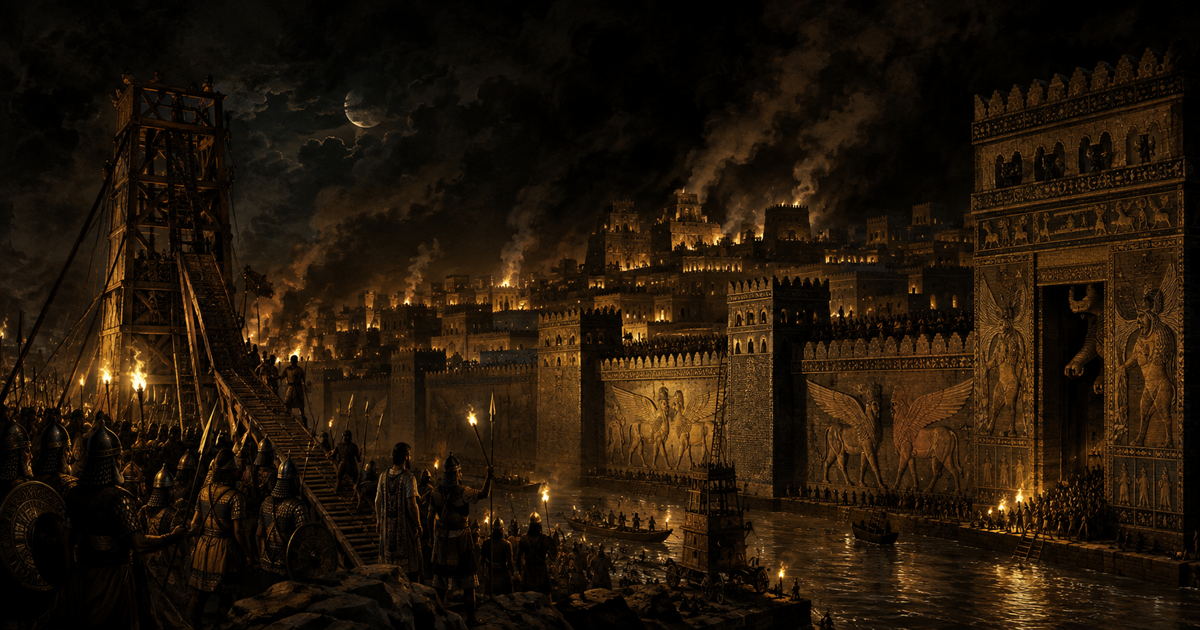
    The crackle of burning roofs filled the air. From the east, the screams broke into short gasps. The walls still held.

    (from the prologue of Threads of Time: Caesar’s Seal)

    Hours later, those walls would hold no longer. It is 612 BC, and that night marks the fall of Nineveh, the most powerful city of its age. On this much, the sources agree. On what actually brought down its defences, they do not agree at all, and the most compelling of the three reconstructions reveals itself as legend the moment you check it against a map.

    What the source closest to the events says

    The Babylonian Chronicle, known through a Late Babylonian copy now held at the British Museum, records a siege from the month of Simanu to Abu, three months, roughly between June and August of 612 BC. It recounts the city’s defeat, the death of King Sin-shar-ishkun, the sack, the reduction of Nineveh to a heap of ruins.

    Not a word about rivers, rain, or dams. On how the defences were actually breached, the text closest to the events says nothing at all.

    The story that gives itself away

    Five and a half centuries later, the Greek historian Diodorus Siculus told a far more cinematic story. He took it from Ctesias, a Greek physician who lived at the Persian court a couple of centuries after the events, whose original text is now lost: we know it only through Diodorus, and it is not always clear where Ctesias ends and later reworking begins. In this version the siege lasts two years, not three months. In the third year, a river in flood breaches the walls, like a prophecy finally fulfilled. King Sardanapalus, portrayed as a dissolute ruler, sets himself on fire in his own palace rather than surrender.

    It is a magnificent scene. It also has a fatal flaw: the river Diodorus names is the Euphrates. Nineveh stands on the Tigris. It is not an isolated slip: the entire city, in the account passed down through Diodorus, is placed on the Euphrates, as if Nineveh had been confused with Babylon.

    This is not a detail to quietly correct, like a typo. It is proof that the tradition had already been rewritten several times before reaching Diodorus. The prophet Nahum, writing before the city’s fall, had already used the image of the river gates opening to describe divine judgement. It may be that this metaphor, over time, was taken literally, and turned into an event that actually happened.

    A serious hypothesis, and an archaeologist who put it to the test

    A more modern hypothesis tries to save the idea of the river while removing the miracle: not a natural flood, but sabotage. Joann Scurlock proposed that the besiegers had deliberately manipulated the waters of the Khosr, the stream running through Nineveh, and its connected channels, to strike a section of the fortifications.

    David Stronach, who between 1987 and 1990 led excavation campaigns at Nineveh focused precisely on the gates, the surviving mudbrick walls, and the city’s water system, put that hypothesis to the test in the field. He concluded that the speed of the siege did not necessarily need to depend on an attack on the Khosr or other watercourses, reduced as they were by the summer season. He preferred another explanation: very long walls, too many gates, and defenders who simply were not enough to hold them all.

    Water as a weapon remains a legitimate hypothesis. It is not, however, what the excavations confirm.

    What the excavations actually show

    Near the Halzi Gate, the earth has yielded a genuine battle scene: human remains, traces of burning, arrowheads and other weapons scattered across the area. The bodies still lay where they had fallen. The passage had been narrowed, and one of the nearby towers had been hastily rebuilt, with irregular masonry, probably in the last desperate years of Assyrian rule.

    It is evidence of a city that had tried to reinforce itself, and that, at least there, at the Halzi Gate, fought to the end. It is not evidence that water decided its fate.

    A declared licence, not a discovery

    Threads of Time: Caesar’s Seal opens on that same night, with a man making real, with his own hands, what posterity would recount as a wonder. The novel chooses one of the hypotheses still open, that of water deliberately diverted, and turns it into an act carried out by someone acting on the orders of a figure who never shows his face.

    This is not what archaeology has proven. It is what an empty space in the sources, a hypothesis never confirmed, and a geographical error that betrays centuries of legend, leave open for someone who writes novels rather than excavation reports to imagine.

    What we still don’t know

    Twenty-six centuries on, we have no settled answer. A chronicle close to the events that does not explain the decisive point. A Greek legend that unmasks itself with a river in the wrong place. A serious hydraulic hypothesis, tested in the field, and ultimately judged unnecessary by the very person who put it to the test. And the signs of a real battle, confirming the violence of the end without explaining how it happened.

    Where and how the walls of Nineveh actually gave way, we will probably never know. It is in that gap, not in an answer, that there is still room to imagine something.

    The prologue quoted at the opening is taken from Threads of Time: Caesar’s Seal, available on Amazon.