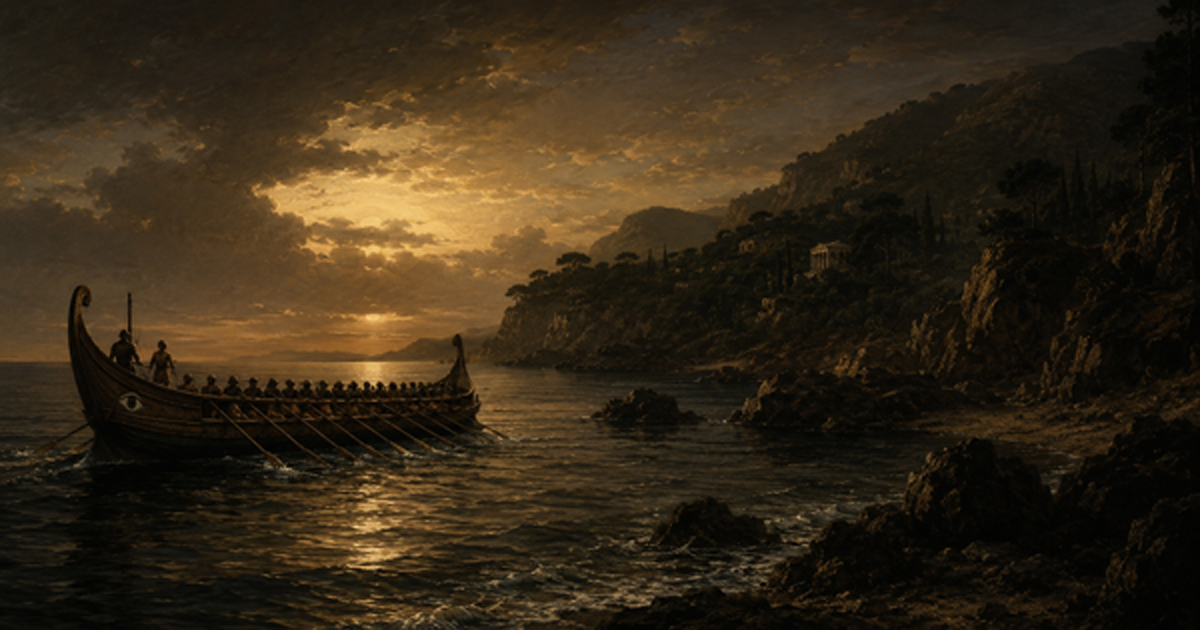
Troy burns.
Odysseus walks through ash. He stopped counting the dead when his son spoke his first words.
(from the prologue of Odysseus)
On 5 July this year, two scholars, one from Cambridge and one from Aberdeen, published a paper that reopens a question taken for granted for millennia. Their argument can be summed up in one sentence: Ithaca was not an island. If they are right, the map of Odysseus’s entire homeward journey needs to be redrawn, and with it part of a much bigger question: how much of that story ever really happened.
Why Ithaca was not an island, according to Homer himself
James Diggle, a classical philologist at Cambridge, started from a detail generations of readers have read without noticing. Homer never calls Ithaca “nesos”, island. He uses “patris”, homeland, or “demos”, territory. The word for island existed, and it scanned perfectly well in the hexameter, yet Homer never chose it for Ithaca.
It is not a minor detail. If the poet was thinking of a region within a larger island, not a self-contained islet, then modern Ithaki, the small island that bears the name today, may simply not be the right place.
An island that doesn’t match the map
The problem is not new. In the Odyssey, Ithaca is described as the lowest-lying and westernmost of a group of islands that includes Same and Zacynthus. Anyone who has visited modern Ithaki knows it is neither the lowest nor especially the westernmost of the neighbouring islands, and excavations there have turned up surprisingly little trace of a significant Mycenaean settlement.
For this reason, for over a century, scholars have proposed alternative candidates. The most discussed is the Paliki peninsula, today part of Cephalonia, a few miles from Ithaki.
The channel that (perhaps) was never needed
In 2005, the project manager Robert Bittlestone, together with the philologist James Diggle and the geologist John Underhill, published Odysseus Unbound: their hypothesis was that in the Mycenaean age a sea channel separated Paliki from the rest of Cephalonia, making it a true island, later filled in by landslides and sediment over the following millennia. The proposal drew international attention, and classicists such as Mary Beard called it plausible, though it never became consensus.
The new 2026 paper changes the argument rather than defending the old one. John Underhill’s geological surveys of the Thinia Valley, which separates Paliki from the rest of the island, found no trace of a permanent sea channel in the Mycenaean age: only rivers and marshland. The channel, in all likelihood, never existed.
No vanished landslide, no geological miracle required. If Homer never called Ithaca an “island”, the channel stops being necessary. Paliki works as a peninsula; it never needed to have broken away from anything. It is a simpler hypothesis than the previous one, not a cosmetic correction of it.
The war that probably happened
On whether a real war lies behind Troy, the consensus has shifted profoundly compared with sixty years ago. In 1968 the historian Moses Finley wrote that the Greeks, in all likelihood, never took Troy.
Since then, the Hittite archives have yielded texts that change the picture. The Alaksandu treaty, an agreement between the Hittite king and a ruler of Wilusa whose name closely echoes Alexandros, the alternative name for Paris in the Iliad. The letter known as the Tawagalawa Letter, which mentions tensions between the Hittites and an Achaean power historians identify with Mycenaean Greece. Neither text names Troy directly, but together they sketch a contested region exactly where Greek tradition places the war.
Joachim Latacz, a philologist at the University of Basel, summed it up in Archaeology magazine: even with every reservation, the answer to whether a real conflict took place is essentially positive.
How to excavate a city, and how to overstate its size
Heinrich Schliemann began digging at Hissarlik in the 1870s, and in his rush to find Homer’s Troy he permanently destroyed the more recent layers, the ones we now know matter most. Wilhelm Dörpfeld, in the 1890s, worked more carefully and was the first to propose Troy VI as the possible city of Homer. Carl Blegen, between 1932 and 1938, shifted attention to the following layer, Troy VIIa, destroyed by fire around 1180 BC.
Between 1988 and 2005, Manfred Korfmann resumed excavations with modern methods and announced a huge discovery: a lower city at the foot of the citadel, which would have brought the settlement to several thousand inhabitants, far larger than previously thought. In 2001 the historian Frank Kolb publicly accused Korfmann of inflating those findings. The dispute reached a two-day conference in Tübingen in 2002, with more than eight hundred attendees.
Subsequent analysis largely confirmed Korfmann’s picture, but with an honest correction: after the criticism, his own team revised the lower city’s population estimates downward. That does not weaken the discovery. It is science correcting itself under scrutiny, and precisely for that reason it remains more credible, not less.
The man who left no trace
On one point the sources are unanimous, and it is the one that most upends expectations. No Linear B tablet, no Hittite archive, no inscription ever names a king of Ithaca resembling Odysseus. As Encyclopaedia Britannica’s own entry on this very question confirms, there is simply no evidence that a man by that name ever existed.
This does not mean Ithaca was uninhabited or lacked its own political structure in the Mycenaean age: the excavations confirm the opposite. It means the specific king, with his cunning and his homecoming, is probably a construction of oral epic, memory of several local rulers fused into a single figure over the centuries, following the mechanism Milman Parry and Albert Lord described for formulaic poetry, before the text was fixed in writing towards the end of the eighth century BC.
What remains, once the legend is set aside
What remains is a war that probably happened, a city whose size was first overstated and then corrected under critical scrutiny, and an island that may never have been where we were looking for it. What does not remain is any proof of a man. Every novel that chooses to give him a face, including Odysseus, adds something the sources can neither confirm nor deny: it is the space where fiction does its work once history stops.